
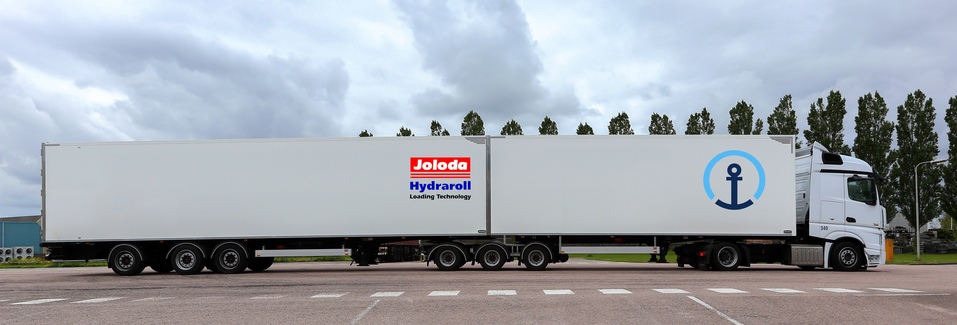
The question of carrying out of the overall weight control of vehicles is provided:
The Law of Ukraine "On Road Transport";
The Law of Ukraine "On Traffic"
Traffic Regulations Approved by the Cabinet of Ministers Resolution of 10 October 2001 (as amended);
Decree No. 879 of the Cabinet of Ministers of June 27, 2007 “On Measures to Preserve Public Roads.
Today, normative documents provide for the carriage of goods with a total mass (together with the mass of the vehicle) - no more than 40 tons.
Additionally:
For container carriers - 44 tons,
for vehicles, according to established by Ukravtodor and corresponding units of the Ministry of Internal Affairs routes up to 46 tons.
In addition, the weight parameters are controlled by the load on the axle - for loading on a single axle - 11 tons, for dual - 16 tons, for the built - 22 tons.
Cross-border movement of vehicles
EU
The maximum dimensions and weight of vehicles for intra-EU transport are set by Directive (EU) 2015/719 of 29 April 2015. Amendments to Directive 96/53 / EC of 1996 allow deviations from the maximum length provided that the aerodynamic performance of the trucks is improved. It also makes them safer due to the extra space in the driver's cab. Deviation from the permissible weight is also allowed for vehicles operating on alternative fuels. With regard to the transboundary movement of vehicles, the dimensions laid down in the original Directive remained unchanged (see Fig. 1).
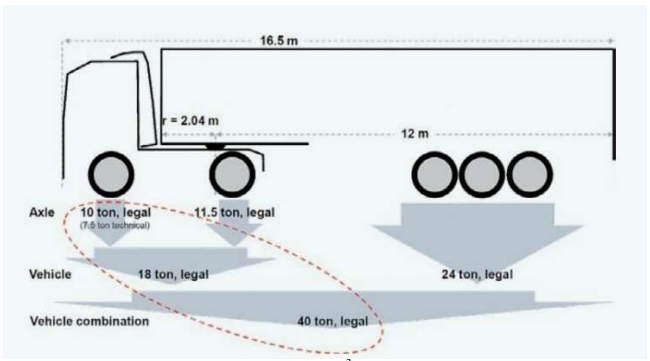
Thus, for vehicles with improved aerodynamic characteristics, the load on a single axle may not exceed 10 tonnes, on a dual axle - 18 tonnes (with a distance of at least 1.3 m and between axles).
not more than 1.8 m), on the built - 24 t (distance between axles not less than 1.3 m and not more than 1.4 m). The total weight of a two-axle vehicle with a three-axle semi-trailer, carrying in the course of intermodal transport operations one or more containers or removable bodies, with a total length of up to 45 feet (13,716 m), may not exceed 42 tonnes; the weight of a similar three-axle vehicle with a two- or three-axle semi-trailer may not exceed 44 tonnes. For two-axle vehicles, with the exception of buses running on alternative fuel, the permissible weight is increased by 1 tonne due to the additional weight required for alternative fuel technology, but may not exceed 19,5 tonnes. The same applies to three-axle vehicles in which the driving axle is fitted with dual tires and pneumatic suspension, or those in which each axle is fitted with twin tires and the maximum weight of each axle does not exceed 9.5 tonnes. The amount of penalties for exceeding permissible standards is governed by national law. onodavstvom EU countries and ranges from several hundred to several thousand euros in different countries. In the UK, a fixed penalty for exceeding the maximum permissible load on one axle is 100 pounds if the excess is less than 10%, 200 pounds - if less than 15% and 300 pounds - if more than 15%. If the excess is 5 tons, or 30%, the driver receives a summons to court. In addition to the fixed fine, regardless of the amount of the violation, the inspector also prohibits the movement of the vehicle. In Ireland, the fine for exceeding the permissible mass of a vehicle by 1-2 tonnes is 500 euros, for 2-3 tonnes - 1000 euros, 3-4 tonnes - 1500 euros, 4-5 tonnes - 3000 euros, for an excess of more than 5 tonnes. is 5,000 euros. In France, fines exceeding 20% are 90 € (reduced), 135 € (standard) and 375 € (increased). A fine of up to EUR 1500 is provided for an excess of 20% or more. In case of repeated exceeding of norms within one year the amount of the fine shall be increased up to 3000 Euro. In Poland, the amount of the fine for excess weight depends on the category of the vehicle and the availability of the appropriate permit. In particular, if the axle load exceeds the limit for roads of 11.5 tonnes (category VII) by less than 10%, a fine of 500 zlotys (about 114 euros) will be charged. If the pressure exceeds the permissible values by 10-20%, a fine of 2000 PLN will be charged. In other cases, the fine will be PLN 15,000 (around EUR 3413).
Canada
In Canada, vehicle loading rates also depend on weather conditions. During the thaw or rain, they are smaller than usual. Under favorable weather conditions, the load on a single axle may not exceed 9 tonnes, on a double axle - 18 tonnes, on a built axle - 21 tonnes (distance between axles should be from 2.4 m to 3 m). For triple axes, the distance between the far axes of which ranges from 3 m to 3.6 m, the maximum weight is 24 t, if the distance between the axes is 3.6 to 3.7 m, the weight is 26 t. thaws these indicators decrease from 21 t to 18 t, from 24 t to 21 t and from 26 t to 22 t, respectively. In the event of a deviation, truck drivers must either distribute the weight more evenly between the axles, or remove excess weight before continuing to drive. Fines for exceeding the established standards in the spring, when the snow melts start at $ 350, the car will stay on the side of the road until the excess weight is lifted. Violations also adversely affect the carrier's profile in the National Safety Code. For vehicles and goods exceeding the permitted limits, the carrier must obtain a special permit. The annual permit is issued when the weight is exceeded within 63.5 t and dimensions are within 25 m (length), 4.26 m (height), 3.7 m (width for highways with two lanes of traffic), 3.85 (width for highways with many lanes) 18. Within the scope of the project permit, transportation of overweight cargo and dimensions on a predetermined steady route is possible for a maximum of 6 months. In this case, the total mass of the vehicle shall not exceed 70 tonnes, width - 4,3 m, and length - 36,75 m19.
USA
In the US, there is a common formula for calculating the permissible weight of vehicles. According to this formula, the maximum permissible weight of vehicles is 80,000 pounds (approximately 36 tonnes). The load on a single axle may not exceed 20,000 lbs (9 tonnes), on a double axle - 34,000 lbs (15,4 tonnes). In addition, many states have additional restrictions and a system of penalties for exceeding applicable standards. For example, in Virginia, gross weights of up to 2,000 pounds are charged 1 cent per pound, while over 12,000 pounds are 20 cents per pound. If the vehicle exceeds the allowable mass by 25%, the payment is doubled, if it is tripled by 50%. In addition, you will be charged a civil fee, a one-time fee, a weight fee, and estimated losses (approximately $ 70). In New York, the penalty for exceeding the permissible axle load of up to 5% is $ 100, and over 30% is $ 2,450. Gross weight of up to 2000 pounds is charged $ 50, up to $ 30,000 - $ 2,700. In California, driving a vehicle in excess of its permissible weight can be punishable by up to 6 months in prison and / or a fine of up to $ 1,000. If the excess weight is less than 4 501 pounds (about 2 tons), the fine will be $ 250.
The information was prepared by Lilia Ovcharova, intern of the USAID RADA Program 2015-2016